

 |
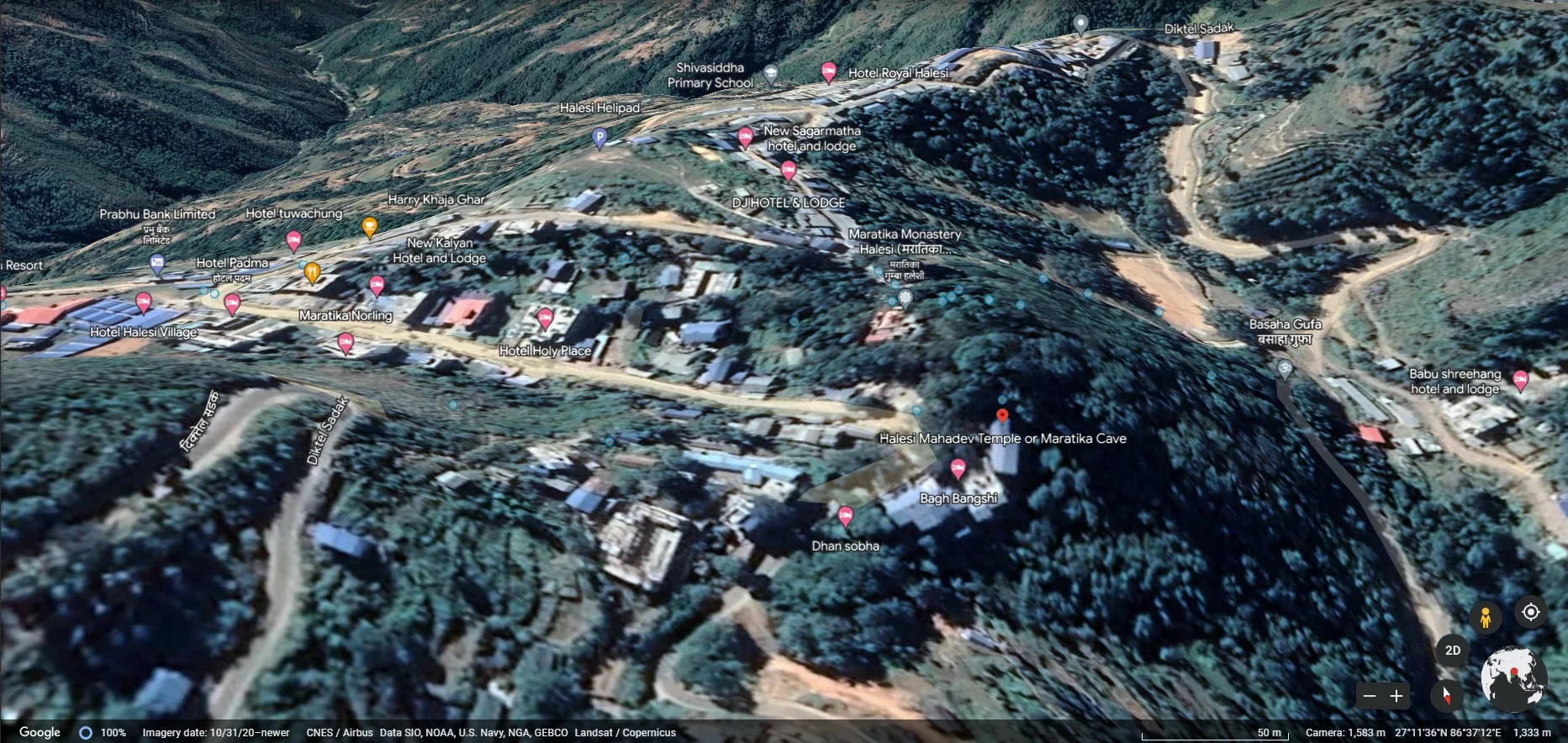
| Halesi Mahadev, Khotang — satellite view |
There is a hole in the hills of Khotang where a god once hid from a demon — and where, much later, a Buddhist master is said to have outwitted death itself. The same cave. The same cool dark. Three faiths walked into it from three directions and all of them stayed.
Halesi Mahadev — also called the Halesi-Maratika Caves — is a sacred cave shrine in Halesi-Tuwachung, Khotang District, in the hills of eastern Nepal. It is a rare tri-religious pilgrimage site: Hindus revere it as the cave where Lord Shiva hid from the demon Bhasmasur and worship the Shiva Linga inside; Vajrayana Buddhists know it as the Maratika Cave, where Guru Padmasambhava (Guru Rinpoche) and Mandarava are believed to have attained immortality; and the indigenous Kirat (Rai) community holds it as an ancestral sacred place.
Often nicknamed the "Pashupatinath of the East," it sits about 220 km from Kathmandu (8–10 hours by road) at roughly 1,430 m elevation. The biggest crowds gather for Maha Shivaratri and Bala Chaturdashi; spring and autumn are the most comfortable months to visit.
- Location
- Halesi-Tuwachung, Khotang District, Koshi Province, eastern Nepal
- Also known as
- Halesi-Maratika Caves · Maratika Cave (Buddhist) · "Pashupatinath of the East"
- Sacred to
- Hindus, Vajrayana Buddhists, and the Kirat (Rai) community
- Main focus of worship
- A roughly two-foot Shiva Linga inside the main cave
- Elevation
- Approx. 1,430 m (about 4,690 ft)
- From Kathmandu
- About 220 km · 8–10 hrs by road, or a flight to Lamidanda plus a drive
- Main festivals
- Maha Shivaratri, Bala Chaturdashi, Ram Navami, Teej
- Best time to visit
- Spring (Mar–May) and autumn (Sep–Nov)
- Entry fee
- None — donations are welcome
Most travelers meet Halesi as a name on a pilgrimage list, somewhere between the better-known temples of the Kathmandu Valley and the trekking trails of the east. That undersells it. Halesi is not a temple with a cave attached; it is a cave that three religions have been unable to stop loving. To stand inside the main chamber — cool, dim, the rock above you hung with the slow work of dripping water — is to stand somewhere that Hindu, Buddhist and Kirat memory all converge on a single point in the dark.
This guide tells the whole story: who holds Halesi sacred and why, what you actually find inside the caves, the famous narrow gates that are said to weigh a pilgrim's conscience, and the practical detail of getting there and choosing your season.
Where is Halesi Mahadev, and why is it called the Pashupatinath of the East?
Halesi sits in Halesi-Tuwachung Municipality in Khotang District, in the middle hills of eastern Nepal, cradled between two sacred rivers — the Dudh Koshi on one side and the Sun Koshi on the other. It is roughly 185 km southwest of Mount Everest as the crow flies, and around 220 km east of Kathmandu by the long, winding hill road. The shrine rests inside a natural cave on a forested ridge at about 1,430 metres, a setting that does as much spiritual work as the rituals themselves.
The nickname "Pashupatinath of the East" is more than marketing. For Hindus across Nepal, the great Pashupatinath in Kathmandu is the supreme seat of Shiva; calling Halesi its eastern counterpart is a way of saying this is the place you go when you cannot go to the capital — and, for many easterners, the place you go instead. The name "Halesi" is often traced to Haresvara, a fusion of Hari (Vishnu) and Ishvara (Shiva) that softened over generations of speech into the word used today; Buddhist tradition offers its own etymology, from a visitor's exclamation at a "place of wonders."
The three traditions that meet in one cave
What makes Halesi genuinely unusual in the Himalaya is that it is not shared grudgingly but wholeheartedly. Three distinct religious worlds each tell their own story about this rock, and none of the stories cancels the others out.
The cave where Shiva hid
In Hindu tradition, Halesi is the refuge where Lord Shiva concealed himself from the demon Bhasmasur, who had won a boon to incinerate anyone he touched. The Shiva Linga in the main chamber is the heart of the site, and devotees come year-round for darshan, Rudri puja and the lighting of lamps. To Hindus it is Mahadevasthan — the abode of the Great God.
Maratika — the cave of immortality
To Tibetan Buddhists the site is Maratika, one of the holiest long-life power places. Here Guru Padmasambhava and his consort Mandarava are said to have received the teachings of the Buddha of Long Life and attained the deathless "vajra body." The caves appear in Himalayan literature as far back as the 12th century, and a Maratika monastery now stands beside them.
An ancestral place of wonder
For the indigenous Kirat — the Rai of these hills — Halesi is an ancestral site. In one telling, a hunter chasing a deer was led to the cave's mouth, saw a strange light within, and discovered a radiant lingam; he forbade hunting near the cave forever after. The site sits within the same Kirat landscape that keeps the Sakela and Sakewa festivals alive today.
Three faiths walked into the same dark from three directions, and all of them came out calling it holy.
Inside the caves: what you actually find
The main cave lies about 67 feet below the surface of the ridge, reached through an entrance shaped like a half-moon that faces east toward the rising sun. Inside, the chamber opens into a roughly circular hall — close to 193 feet across, with a floor that runs some 223 feet around — its ceiling and walls thick with stalactites and stalagmites built drop by drop over uncountable years. A second cave lies below the first, and the wider complex is often described as three caves in all, read by pilgrims as the three faces of the divine.
The focus of it all is a Shiva Linga roughly two feet tall, set deep in the rock. Near it stand two stone pillars so close together that only a narrow gap separates them — the famous test where, by tradition, a true heart can squeeze through and a guilty one cannot. The cave is genuinely dark and the floor can be slick; a small light and careful footing matter more here than at any tidy valley temple.
The five Dwars — gates that weigh the soul
Around and within the cave system run a set of tight natural passages that pilgrims crawl and squeeze through, each given a name that turns the act of passing into a small moral reckoning:
- Paap Dwar — the "gate of sin," whose tightness is said to reveal the weight a pilgrim carries.
- Dharma Dwar — the "gate of virtue," passed in hope of merit.
- Swarga Dwar — the "gate of heaven," associated with liberation.
- Garbha Dwar — the "womb gate," a symbol of rebirth and renewal.
- Karma Dwar — the "gate of deeds," tied to the fruits of one's actions.
Whether or not you read these as literal judgements, crawling through cold stone in the half-dark is a powerful thing to do with your body, and it is part of why pilgrims describe leaving Halesi feeling lighter than when they arrived.
When does Halesi come alive? The festivals
Halesi is busiest, loudest and most moving during its festivals, when the quiet cave becomes a tide of lamps and chanting.
Maha Shivaratri (February–March) is the great night of Shiva and the largest gathering of the year — tens of thousands of devotees, all-night vigils, and a queue for the cave that can stretch for hours. Bala Chaturdashi (November–December) brings pilgrims who scatter grains and light lamps in memory of the dead. Ram Navami and Teej draw their own crowds, and the cave also hosts countless personal rites through the year — Rudri pujas, the lighting of a hundred thousand lamps (lakh batti), weddings and the bratabandha coming-of-age ceremony. For the Buddhist community, Maratika is a site for long-life rituals and Lhosar observance.
How do you reach Halesi Mahadev?
Halesi is remote by Kathmandu standards, and the journey is part of the pilgrimage rather than an obstacle to it. By road it is roughly 220 km and 8–10 hours from the capital, the route running through Dhulikhel, Nepalthok, Khurkot, Ghurmi and Okhaldhunga before the final climb on a narrow hill road. Travelers short on time can fly to Lamidanda airport and drive the remaining stretch, or charter a helicopter, which turns the trip into a matter of hours. There is no entry fee; the site runs on donations, and simple lodges and teahouses near the cave handle food and an overnight stay — worth booking ahead during festival season.
Bring a light and sensible shoes. The cave is dark and the rock is often wet; a phone torch and grippy footwear make the narrow passages safe rather than stressful.
Dress modestly and follow the queue. This is a living shrine, not a viewpoint. Cover shoulders and knees, remove shoes where asked, and let the rhythm of the pilgrims set your pace.
Ask before photographing rituals. The caves and the monastery are places of active worship; a quiet gesture toward your camera is usually all the courtesy that's needed.
Time it on purpose. Come at Shivaratri for overwhelming atmosphere and crowds, or in clear spring and autumn weeks for space, green hills and an easier journey.
Key terms, defined
- Maratika
- The Buddhist name for the Halesi caves — a sacred Vajrayana "long-life" power place associated with Guru Padmasambhava and Mandarava.
- Bhasmasur
- The demon of Hindu legend who could burn anyone he touched; Shiva is said to have hidden in the Halesi cave to escape him.
- Shiva Linga
- The aniconic symbol of Lord Shiva; the roughly two-foot linga inside the main cave is Halesi's central object of worship.
- The Dwars
- Narrow natural passages — Paap, Dharma, Swarga, Garbha and Karma Dwar — that pilgrims pass through as symbolic tests of conscience and rebirth.
- Pashupatinath of the East
- Halesi's popular epithet, ranking it alongside Kathmandu's Pashupatinath as a supreme Shiva shrine for eastern Nepal.
- Bala Chaturdashi
- A Hindu festival of remembrance at which pilgrims scatter grains and light lamps for deceased ancestors — a major occasion at Halesi.
Key takeaways
- Halesi Mahadev, in Khotang's Halesi-Tuwachung Municipality, is a cave shrine in the hills of eastern Nepal, between the Dudh Koshi and Sun Koshi rivers.
- It is a rare tri-religious site: Hindu (Shiva's refuge from Bhasmasur), Buddhist (Maratika, linked to Padmasambhava and Mandarava), and Kirat (an ancestral sacred place).
- The main cave lies about 67 feet below ground, holds a two-foot Shiva Linga, and is part of a complex famous for its five symbolic Dwars (gates).
- It is widely known as the "Pashupatinath of the East."
- The biggest festivals are Maha Shivaratri and Bala Chaturdashi; spring and autumn are the most comfortable times to go.
- It lies about 220 km from Kathmandu (8–10 hours by road, or a flight to Lamidanda plus a drive); there is no entry fee.
Frequently Asked Questions
What is the Halesi Mahadev temple, and where is it located?
Halesi Mahadev, also called the Halesi-Maratika Caves, is a sacred cave shrine in Halesi-Tuwachung Municipality, Khotang District, in eastern Nepal. It is revered by Hindus as an abode of Lord Shiva, by Buddhists as the Maratika long-life cave, and by the Kirat community as an ancestral site — and is widely known as the "Pashupatinath of the East."
Why is Halesi sacred to three religions?
Hindus believe Shiva hid here from the demon Bhasmasur and worship the cave's Shiva Linga. Vajrayana Buddhists know the site as Maratika, where Guru Padmasambhava and Mandarava are said to have attained immortality. The indigenous Kirat (Rai) hold it as an ancestral place tied to a hunter who discovered a radiant lingam in the cave. All three traditions venerate the same rock.
What is the Maratika Cave?
Maratika is the Buddhist name for the Halesi caves. In Vajrayana tradition it is one of the holiest "long-life" power places, where Guru Padmasambhava (Guru Rinpoche) and his consort Mandarava received the teachings of the Buddha of Long Life and realized the deathless vajra body. The caves are referenced in Himalayan literature as early as the 12th century.
What are the unique features of the Halesi caves?
The main cave lies about 67 feet below the surface, with a half-moon entrance facing east and a roughly circular hall hung with stalactites. Its highlights are a two-foot Shiva Linga, a narrow gap between two pillars said to test a pilgrim's conscience, a second cave below, and the five symbolic gates — Paap, Dharma, Swarga, Garbha and Karma Dwar.
How can one reach the Halesi Mahadev temple?
From Kathmandu it is roughly 220 km and 8–10 hours by road, via Dhulikhel, Nepalthok, Khurkot, Ghurmi and Okhaldhunga. Alternatively, fly to Lamidanda airport and drive the rest, or charter a helicopter to cut the journey to a few hours. Simple lodges near the cave provide food and overnight stays.
What is the best time to visit Halesi Mahadev?
Spring (March–May) and autumn (September–November) offer the most comfortable weather and clearest hill scenery. For atmosphere, time your visit to Maha Shivaratri (February–March) or Bala Chaturdashi (November–December) — but expect very large crowds and long queues at the cave.
Is there an entry fee for Halesi Mahadev?
No. There is no entry fee to the temple or caves; the site is maintained largely through voluntary donations from pilgrims.
About this guide: Compiled for readers of Nepali and Kirat heritage, cross-referencing Nepal Tourism Board and local pilgrimage sources, published descriptions of the Halesi-Maratika cave complex, and Vajrayana accounts of Maratika. Distances, elevation and cave measurements are widely reported figures and may vary slightly between sources. Festival dates follow the lunar Hindu calendar and shift each year — verify locally before travelling. Last updated June 2026.

Hi! Please, Do not Spam in Comments